
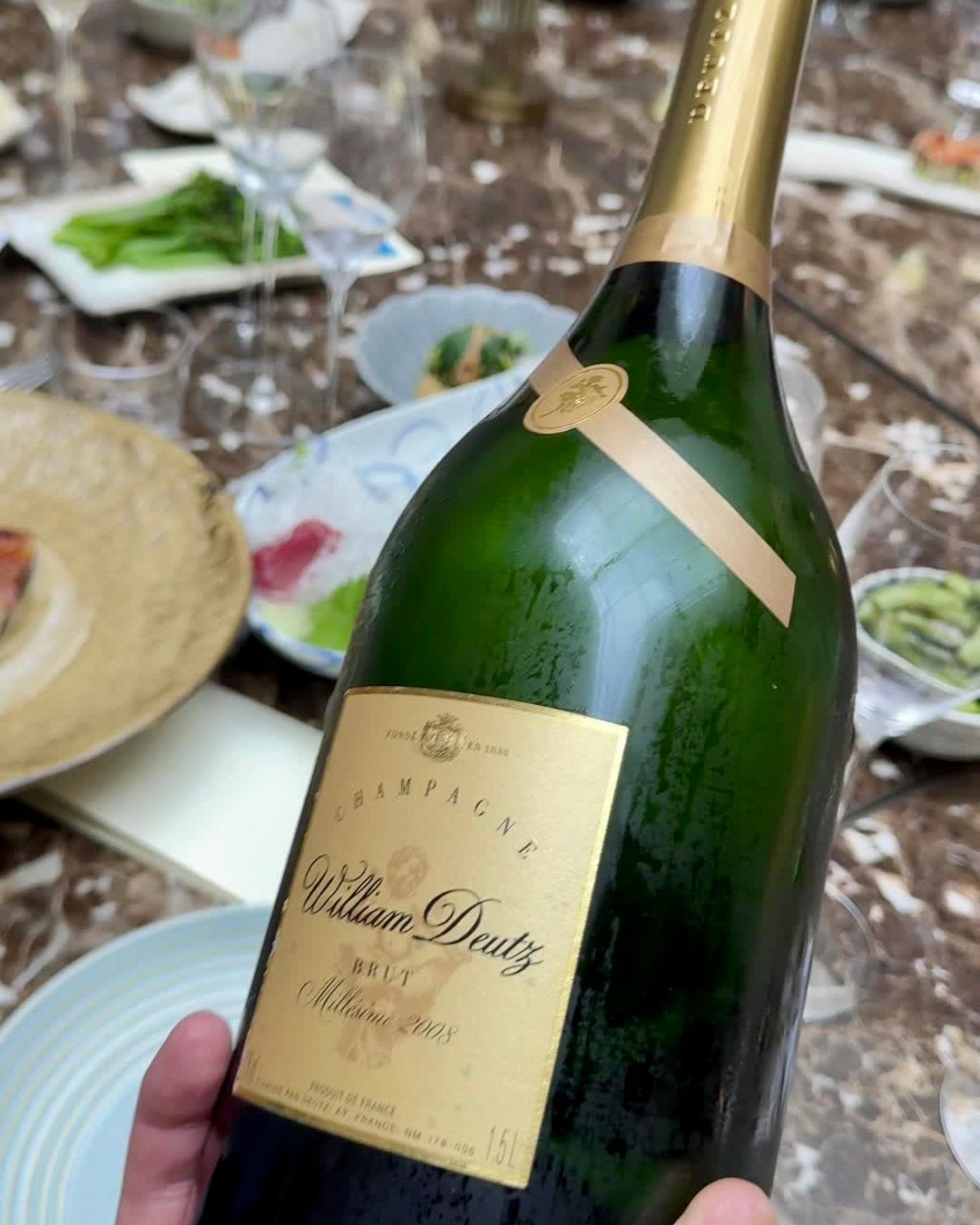
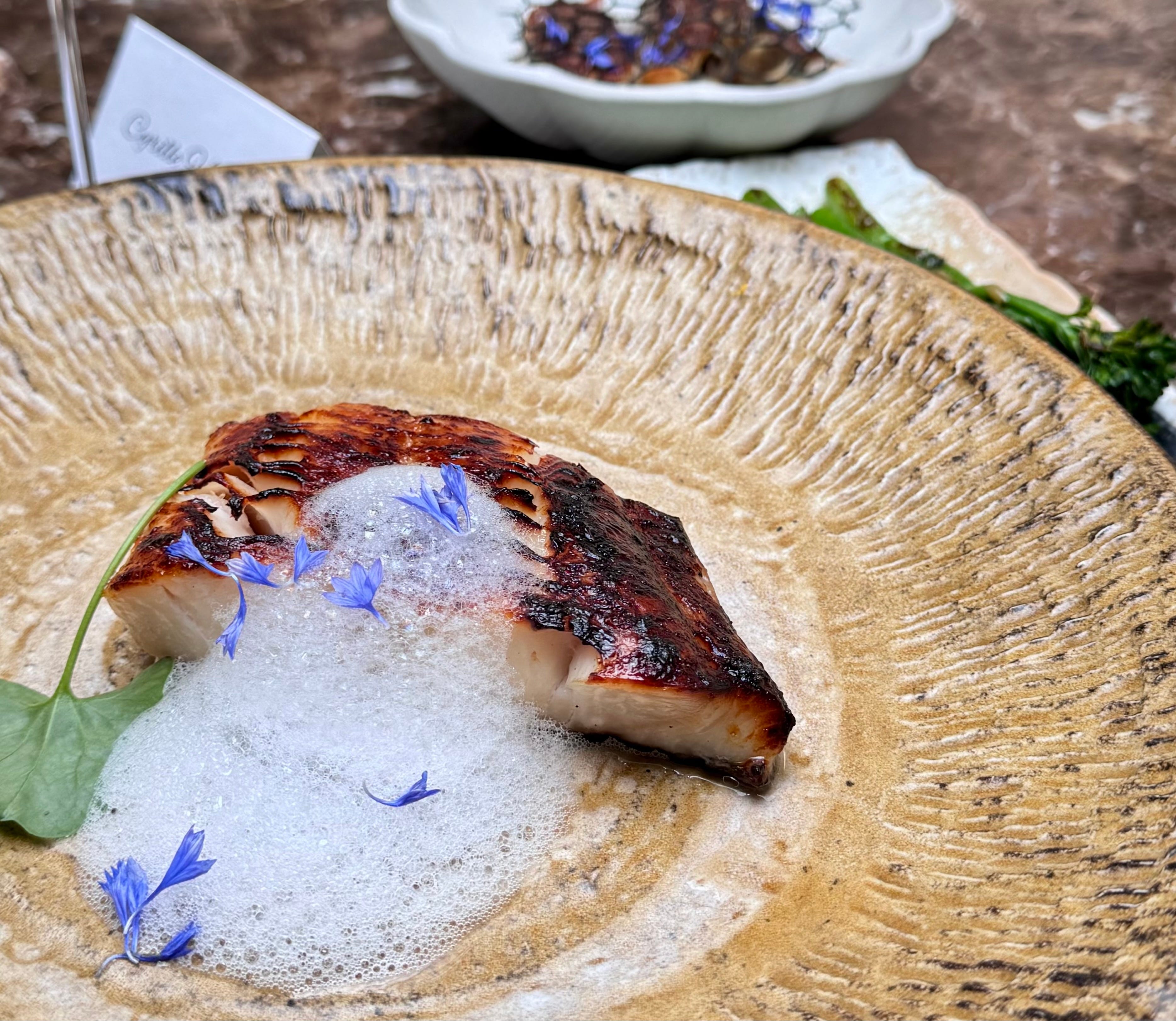
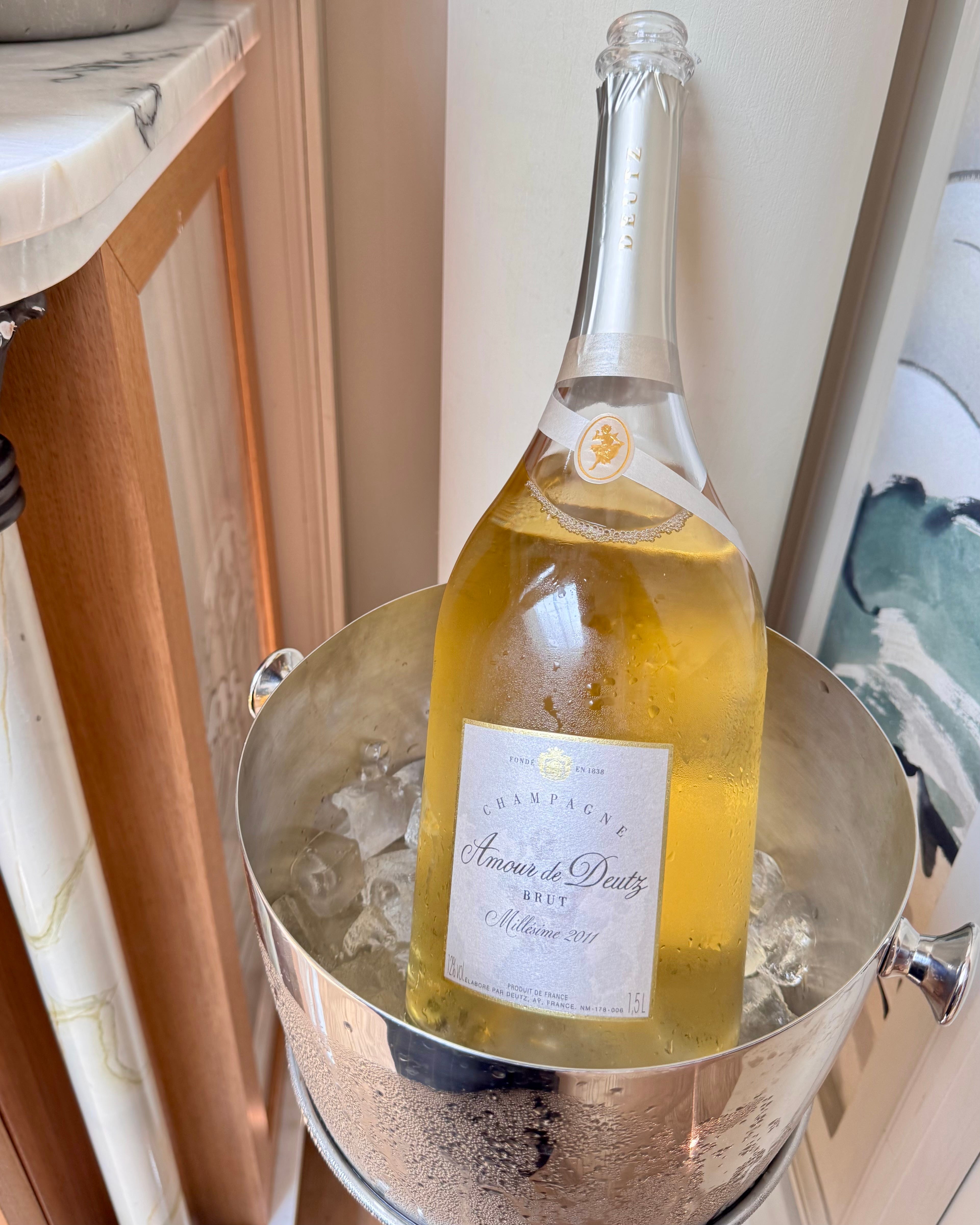
Two magnums came to the table together — Cuvée William Deutz 2008 in dark green under gold foil, Amour de Deutz 2011 frosted white and beaded with condensation — and were set beside caramelised black cod. Fourth course, in a private room at Aki London, on a Friday afternoon in late July.
By that point Champagne Deutz had finished making an argument it never once stated aloud.
The shape of the meal
Seven wines came to the table over lunch, four of them in magnum.
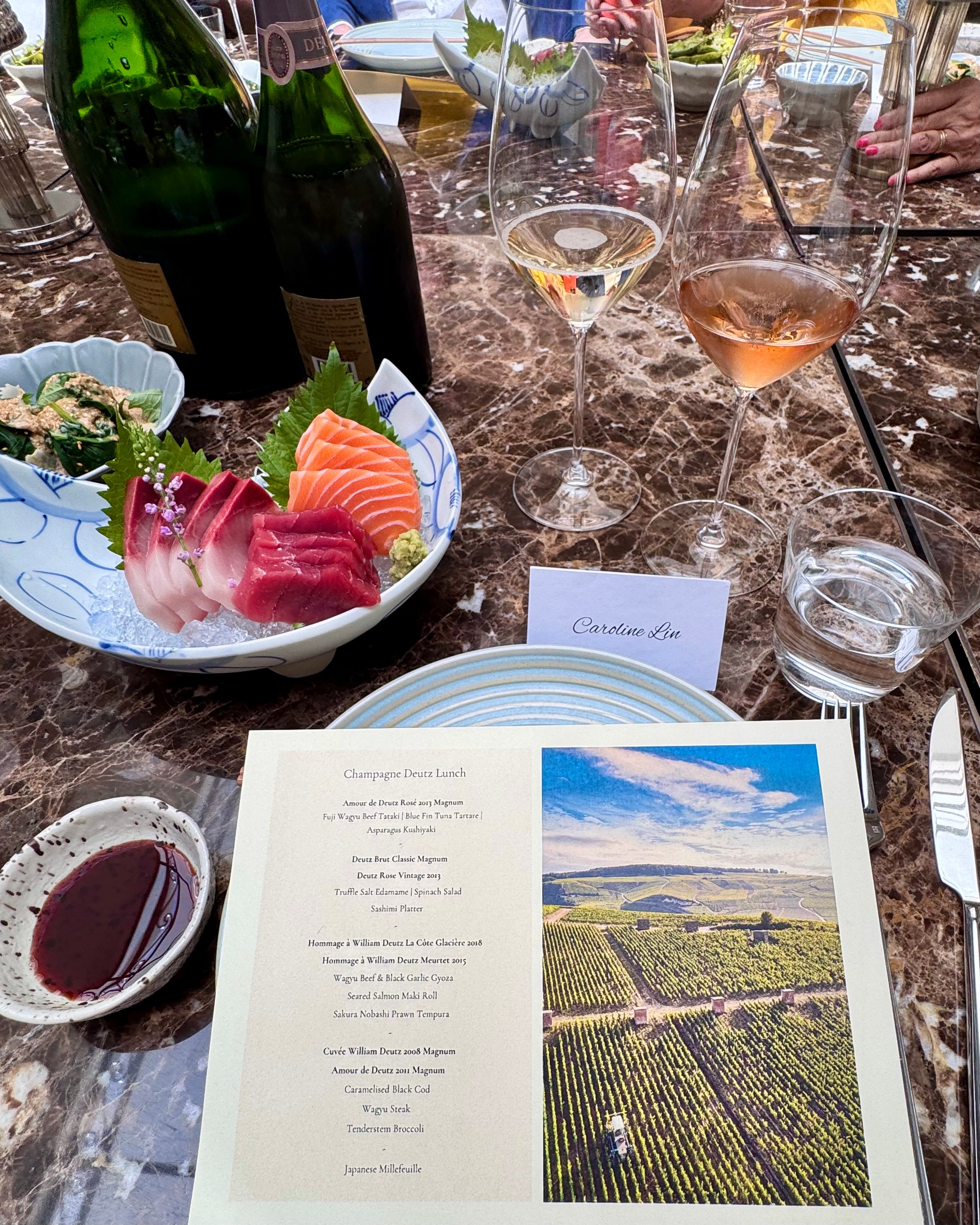
The first course was Amour de Deutz Rosé 2013 in magnum: Pinot Noir and Chardonnay, drawn across several villages. The second brought Brut Classic in magnum alongside Rosé Vintage 2013, predominantly Pinot Noir with a proportion of red wine from historic plots in Aÿ. Then the third course narrowed to a point. Two wines, each from a single plot of Pinot Noir adjacent to the Deutz premises in Aÿ: Hommage à William Deutz La Côte Glacière 2018 and Meurtet 2015. And the fourth course widened back into assemblage, with Cuvée William Deutz 2008 and Amour de Deutz 2011.
Blends, then two plots of Aÿ, then blends again.
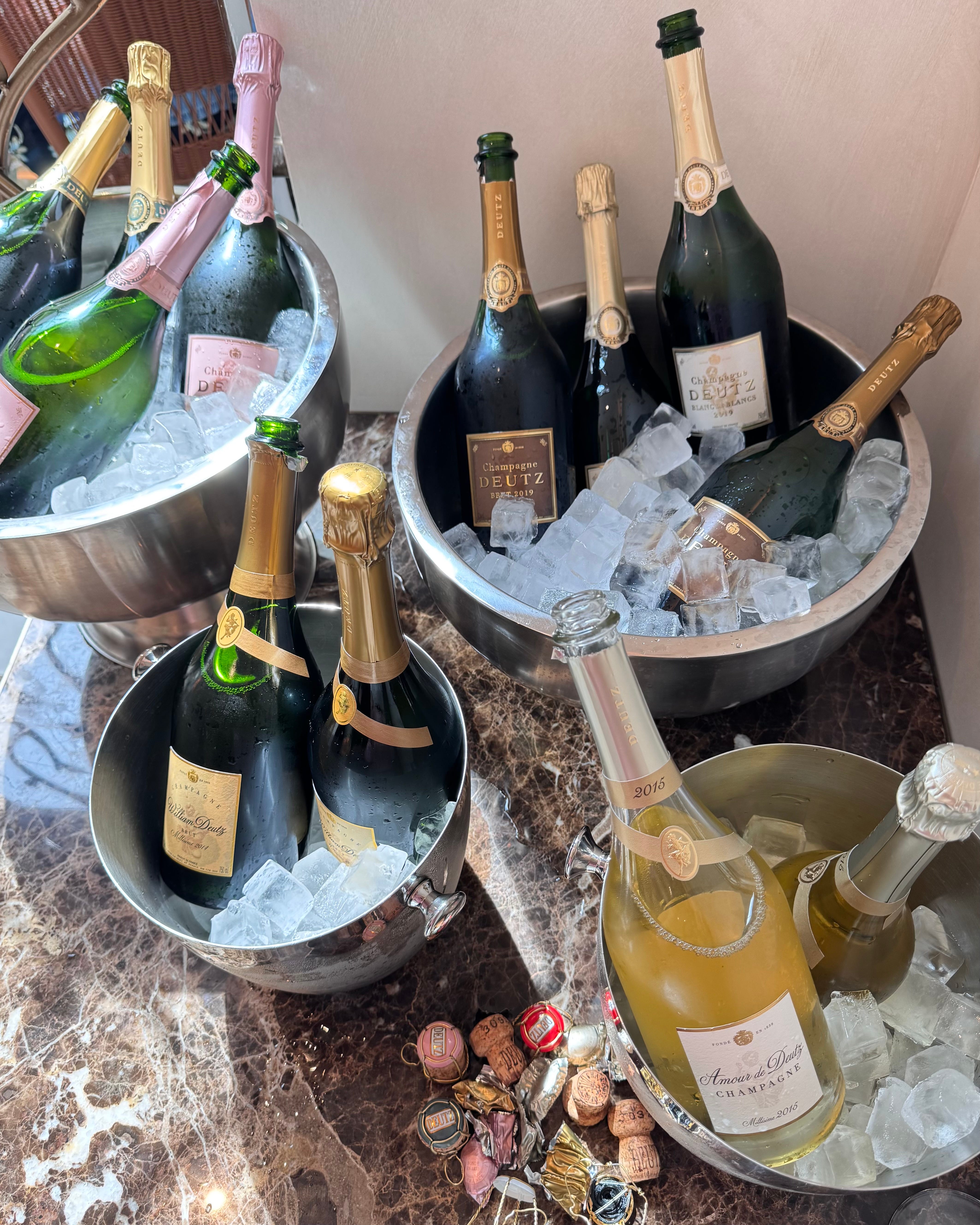
Nor were the two single-vineyard wines in the morning masterclass. That flight, led by export director Cyrille Harmel, ran through Brut Classic, Brut Rosé, the 2019 Vintage and Blanc de Blancs, Cuvée William Deutz 2014 and Amour de Deutz 2015 — the house explaining itself in the usual order.
Blending is where Deutz locates its signature; the house says so plainly, calling it an exercise in freedom. Caroline Latrive, cellar master since 2022, works from a palette of more than 220 vats and ninety individually vinified crus — a scale of separation that will sound familiar to anyone who knows Krug. Almost all of it goes into the house cuvées, under labels that name no vineyard at all.
Two plots are exempt. Both lie in Aÿ, where the house has stood since 1838, and they are the only ground Deutz allows to sign its own name.
The plots
They are small: La Côte Glacière 1.9 hectares, Meurtet 2.4. The first sits immediately beside the house, the second a short way off, both within what is now the UNESCO-protected core of the Champagne vineyard. The house’s account is that William Deutz acquired them in 1838, the year he and Pierre-Hubert Geldermann — the Prussian négociant from Aachen and his business partner — established themselves at Aÿ.
Deutz began as a négociant house with little land of its own, and La Côte Glacière was pieced together from around ten very small gardens that William Deutz managed to acquire. Whatever the precise year, the two hillsides passed down six generations of the founding family, from William Deutz to the Lalliers, who married into it in 1906 and ran the house until Louis Roederer bought it in 1993. For almost all of that time their fruit went into blends. Excellent blends. But their identity dissolved into something larger, which is what Champagne has traditionally asked of even its finest ground.
Champagne as a whole worked this way; in a typical village something like nine-tenths of the crop still disappears into an assemblage, and the modern single-vineyard movement only gathers pace after Krug’s Clos du Mesnil in 1979. But the argument that one hillside could speak for itself had already been made in 1935, at Philipponnat’s Clos des Goisses in Mareuil-sur-Aÿ — the next village along, on the same run of south-facing slope. A short walk from the Deutz door. Deutz took another seventy-five years to make the same argument about its own ground.
When it came, it came properly. The two plots were bottled together as Parcelles d’Aÿ from the 2010 harvest, around six thousand bottles; from 2012 they were separated, one wine from each slope, made only in years judged to justify it. There have been three such years: 2012, 2015 and 2018. The plural on the label became singular. Parcelle d’Aÿ.
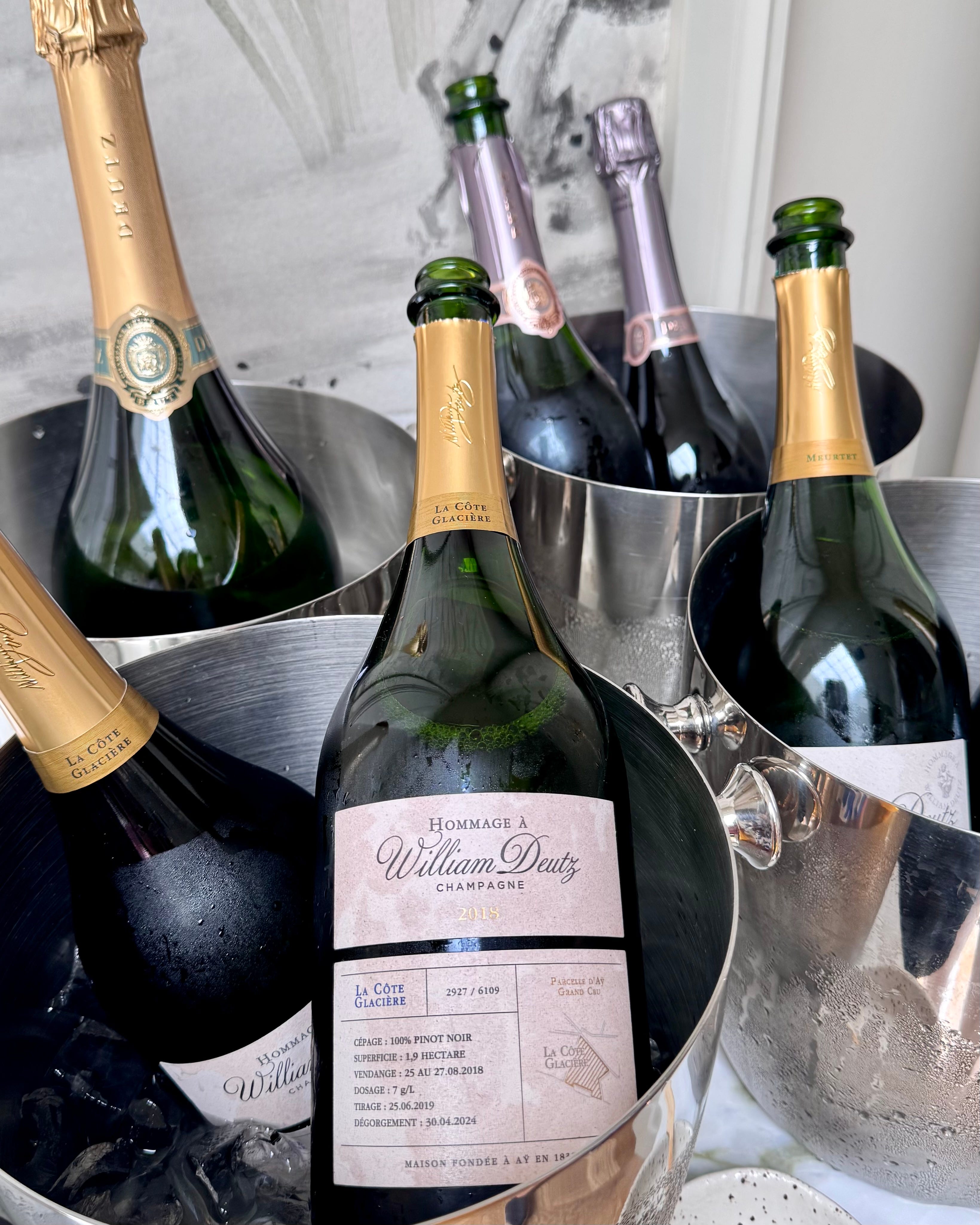
The label reads like a document — Hommage à William Deutz, 2018, and beneath it a boxed panel: La Côte Glacière, Parcelle d’Aÿ Grand Cru, bottle 2,927 of 6,109. Cépage, 100% Pinot Noir. Superficie, 1.9 hectares. Vendange, 25 to 27 August 2018. Dosage, 7 g/L. Tirage, 25 June 2019. Dégorgement, 30 April 2024. Beside it, a small line drawing of the plot itself.
Barely five hundred cases, each carrying its picking dates on the face of the bottle, in the space a house would ordinarily give to a crest.
The two sites differ in ways that can be measured. La Côte Glacière faces south on a 25% slope, its old vines planted in 1967, the chalk sitting 70cm beneath the surface — a cold name on warm ground. Meurtet faces east into the morning sun, gentler at 15%, its soils deeper and its vines younger, giving generous yields and, the house says, a wonderfully consistent expression. That year Meurtet was not picked until 3 September. Both are labelled Blanc de Noirs; both spend six years in the cellars. Winemaking is otherwise identical, and the single variable Latrive adjusts is dosage: a cellar decision taken in service of the plot, calibrated to each rather than stamped across the range.
Three years apart
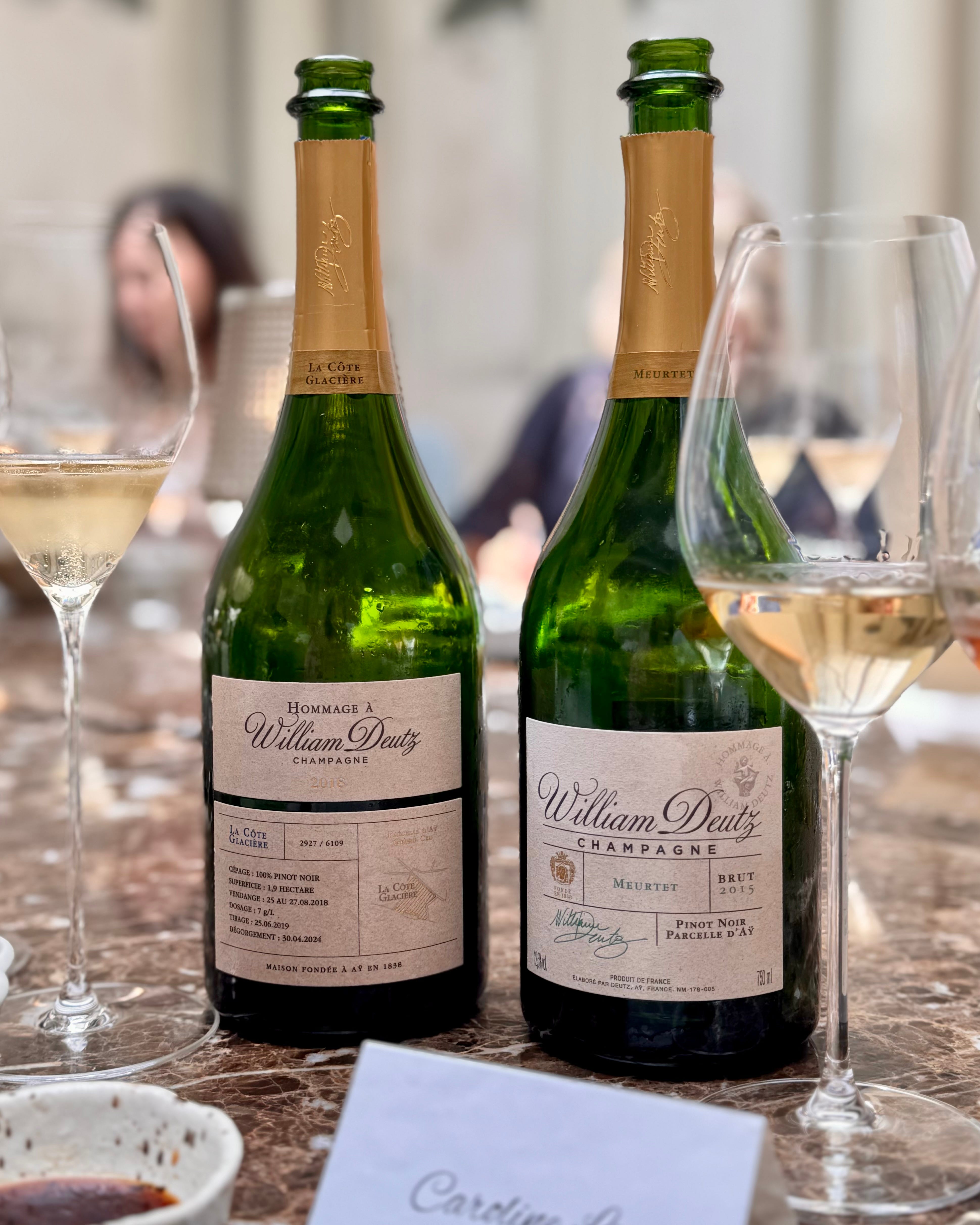
At Aki they arrived together with wagyu and black garlic gyoza, seared salmon maki and prawn tempura — and three years apart: La Côte Glacière 2018 beside Meurtet 2015. Both plots were declared in all three vintages, so a matched pair exists, and was not what we were given.
La Côte Glacière 2018 was the broader and more generous: ripe red and dark fruit, ample Pinot weight, a saline line running beneath the warmth. Meurtet 2015 was quieter and more tightly drawn, redcurrant and chalk on a finer frame.
Which is the wrong way round, and that is the point. Meurtet was the older wine by three years and ought to have been the more open glass. It was the more reserved.
Slope is not the only variable: the Côte’s vines were planted in 1967 against Meurtet’s 1990, and vine age is doing some of the work I might otherwise credit to aspect. Nor do I have the two figures that would settle it — the 2015 Meurtet’s dosage and its disgorgement date, neither of which appears in the house’s own materials — and in Champagne time on cork can matter more than time in the vintage. Within the 2018 pair, Latrive herself places the “Aÿ salinity” in the Meurtet, the opposite of where I found it.
What survives all of that is temperament, and it happens to match how Latrive herself describes them: Meurtet restrained and delicate, an incarnation of precision; La Côte Glacière a majestic, opulent expression of Aÿ Pinot Noir. I had written my version down before I read hers.
The cherub in the courtyard
Then the meal opened out again, and the fourth course made the counter-case.
A small bronze cherub stands in the cour d’honneur at Aÿ, in front of the house. In 1999 Deutz launched a prestige cuvée named after it, releasing the 1993 vintage. Amour de Deutz — the white — is 100% Chardonnay, predominantly Grands Crus of the Côte des Blancs with a touch of Premier Cru from the Montagne de Reims, and a minimum of nine years in the cellars. The 2011 we drank was led by Avize at half the blend. Nothing from Aÿ.
It could hardly have been otherwise. Aÿ is planted to 89% Pinot Noir and barely 8% Chardonnay — a village that decided long ago what it was for. A house wanting a great Blanc de Blancs there has to look elsewhere.
The house calls Amour a love letter to the Champagne region, and Harmel, asked which cuvée he would most want people to know, named it without hesitation. To the region. Not to Aÿ.
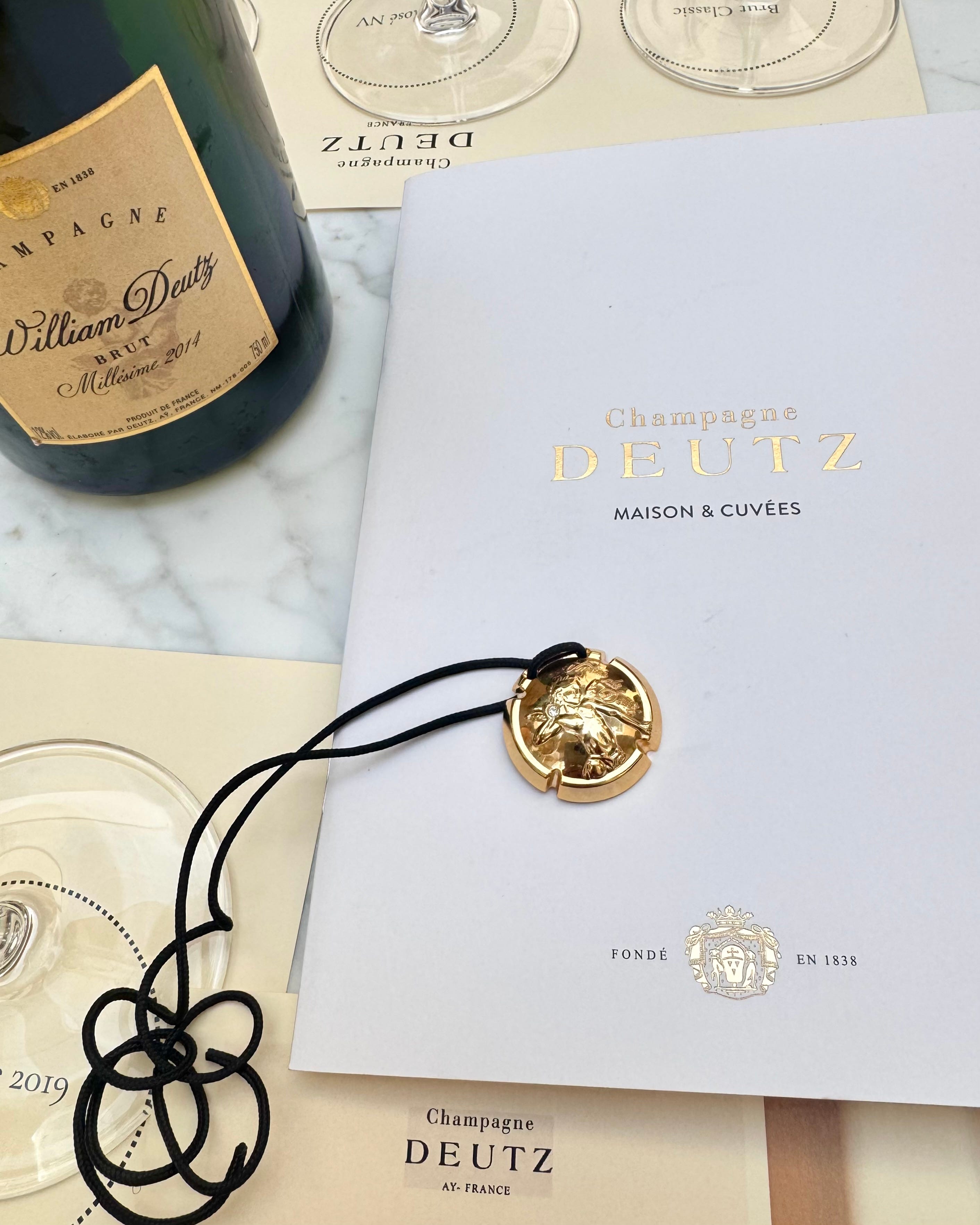
Nor has Deutz been shy about dressing it. The muselet cap is a Pascal Morabito jewel — gold-plated, a cherub loosing an arrow, a stone set at the point of release, Fondé en 1838 on the reverse, threaded on a cord and plainly meant to be worn: gold for the Blanc de Blancs, rose for the Rosé.
Against the black cod, Amour de Deutz 2011 was the more luminous of the pair: ripe pear and stone fruit, a touch of pastry, fine mousse, a freshness that tightened rather than faded, cutting through the caramelised sweetness. The Cuvée William Deutz 2008 beside it worked in the opposite direction, meeting the weight of the dish rather than lifting it. Amour lifted; William met. Two prestige cuvées, two grape varieties, one plate of fish, two ideas of authority.
And 2011 was no incidental choice of year. It was a difficult harvest and few houses elaborated a vintage from it; erratic weather left the black grapes variable while Chardonnay came through markedly better. Deutz knows this better than most, having skipped 2011 for the Hommage precisely because the vintage was poor for Pinot Noir.
So the plots beside the house were passed over that year. The Côte des Blancs was not. A house that had spent generations declining to name its own hillside found, in a difficult vintage, that the ground twenty kilometres south was the ground that could still speak.
The name on the label
Which leaves the wine carrying the founder’s name outright. Cuvée William Deutz pays homage, the house says, to the great Pinot Noirs of the Montagne de Reims, lifted by Chardonnay, with a few per cent of Meunier depending on the year. It spends a decade in the cellars, which is why a 2008 was on the table in 2026 and did not feel like archaeology.
There is an irony in the naming. The blend bears the founder’s name, and the house points it north to another range of hills; the plots he acquired at his own door carry his name only as tribute — Hommage à. He is the brand on one and the dedicatee on the other.
The format is less incidental than it looks. Deutz specifies a 26mm glass ring at the neck of its bottles — narrower, the house says, than the Champagne standard — designed to recreate the ageing conditions of a magnum. It is not alone in this — Krug and Bruno Paillard were there first — but a house that spends its ingenuity making 75cl behave like 1.5L, and then opens four actual magnums across a single lunch, is telling you what it believes time does.
And at eighteen years the 2008 was entirely unhurried. Fruit had stopped leading: quince and red apple behind chalk, hazelnut, toast, a faint smokiness. The texture was the more striking thing — ample through the middle but tightly woven with it, the mousse so fine it had almost been absorbed into the wine, acidity still holding the finish to a point. Maturity without decline, and plainly not finished.
The reintroduction
All of this reaches Britain at a particular moment. Deutz has been hard to find here — surprisingly so for a house of this standing, in a market that takes Champagne as seriously as any — and it has now moved from its former importer to sit alongside Delas Frères under MMD. An old pairing reunited, since Deutz bought the Rhône house in 1977 and both passed to the Rouzaud family of Louis Roederer in 1993. Deutz remains a standalone operation with its own site, team and winemaking. The 2018 single-vineyard pair was launched in London the previous summer; this lunch was a reintroduction, not a debut.
And the house doing the reintroducing is not quite the one that left. Latrive arrived in 2022 to succeed Michel Davesne, whom she had first met as an intern in 1999. She came from Ayala — another house in Aÿ, and another that made its name on Chardonnay in the middle of Pinot country — where she was known for a Chardonnay-led style and a light hand with dosage. The two adjustments set out at the masterclass, more chalk-driven Chardonnay in the classic blends and a lower standard dosage, are those same instincts arriving at a new address.
The firmer numbers all point homeward. Deutz sources within twenty kilometres of Aÿ, primarily from Grands and Premiers Crus, classifications amounting to about a fifth of the Champagne vineyard, from its own vines and from long-standing partner growers. It holds High Environmental Value and Sustainable Viticulture in Champagne certification, and is gradually converting its vineyards to organic growing.
The range now divides into four groups: Multi-Vintage, Gastronomic Vintage, Prestige — and, standing apart from all of them, Single Vineyard Expressions from Aÿ. The house did not slot its plots in beside the prestige cuvées. It built them a category of their own.
Not a house abandoning assemblage for terroir, but one insisting on both at once, and arranging a lunch so that the argument passes through the middle of the meal and out the other side. Ninety crus vinified apart each year, nearly all of them bound to disappear into something larger. Two plots, inside one of those crus, allowed to say their own names.
Somewhere in Aÿ a bronze cherub stands in a courtyard with a Chardonnay named after him. Beside him, on a 25% slope, two small parcels of Pinot Noir have finally been allowed to say where they are from.
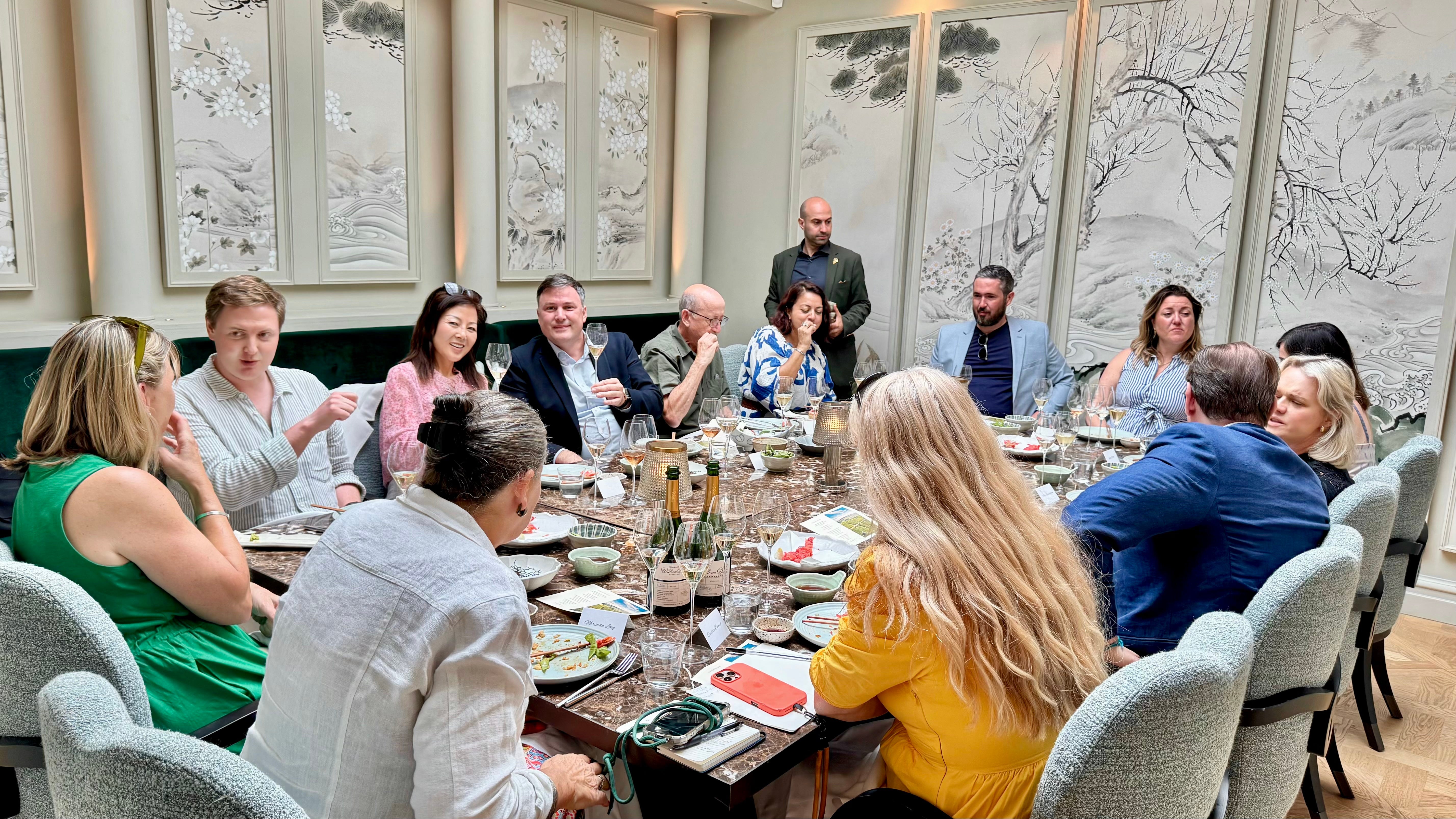
Champagne Deutz is distributed in the UK by MMD. Caroline Lin attended the masterclass and lunch at Aki London on 24 July 2026 as a guest of the house.
More from Palate Journal


