Christmas in July
An eleven-year-old English Blanc de Blancs, six cheeses from Britain’s oldest cheesemonger, and the quiet case for looking again at what we reach for.

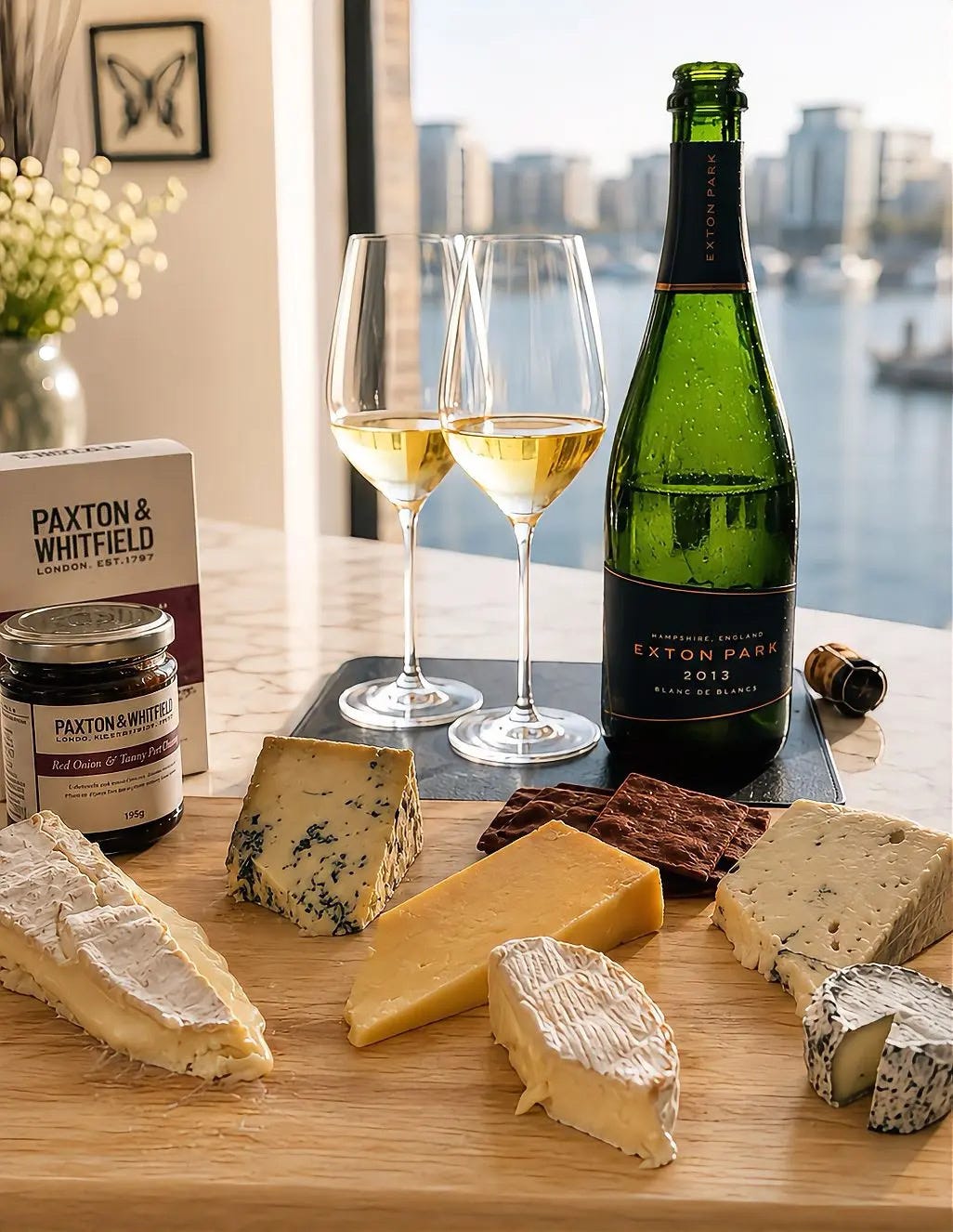
Christmas is a season we run largely on memory — the same board, the same bottle, chosen out of habit rather than attention. Meeting a festive cheeseboard in the last week of July, windows open, the year at its warmest, switches the autopilot off. You notice what you are actually reaching for.
What I reached for was an English wine to sit beside an English board. We have spent a decade being told that English sparkling can stand beside Champagne; we have spent rather less time asking what it belongs beside on our own tables. The more I turned it over, the less it felt like novelty and the more like a recalibration — a correction to something we thought we already knew.
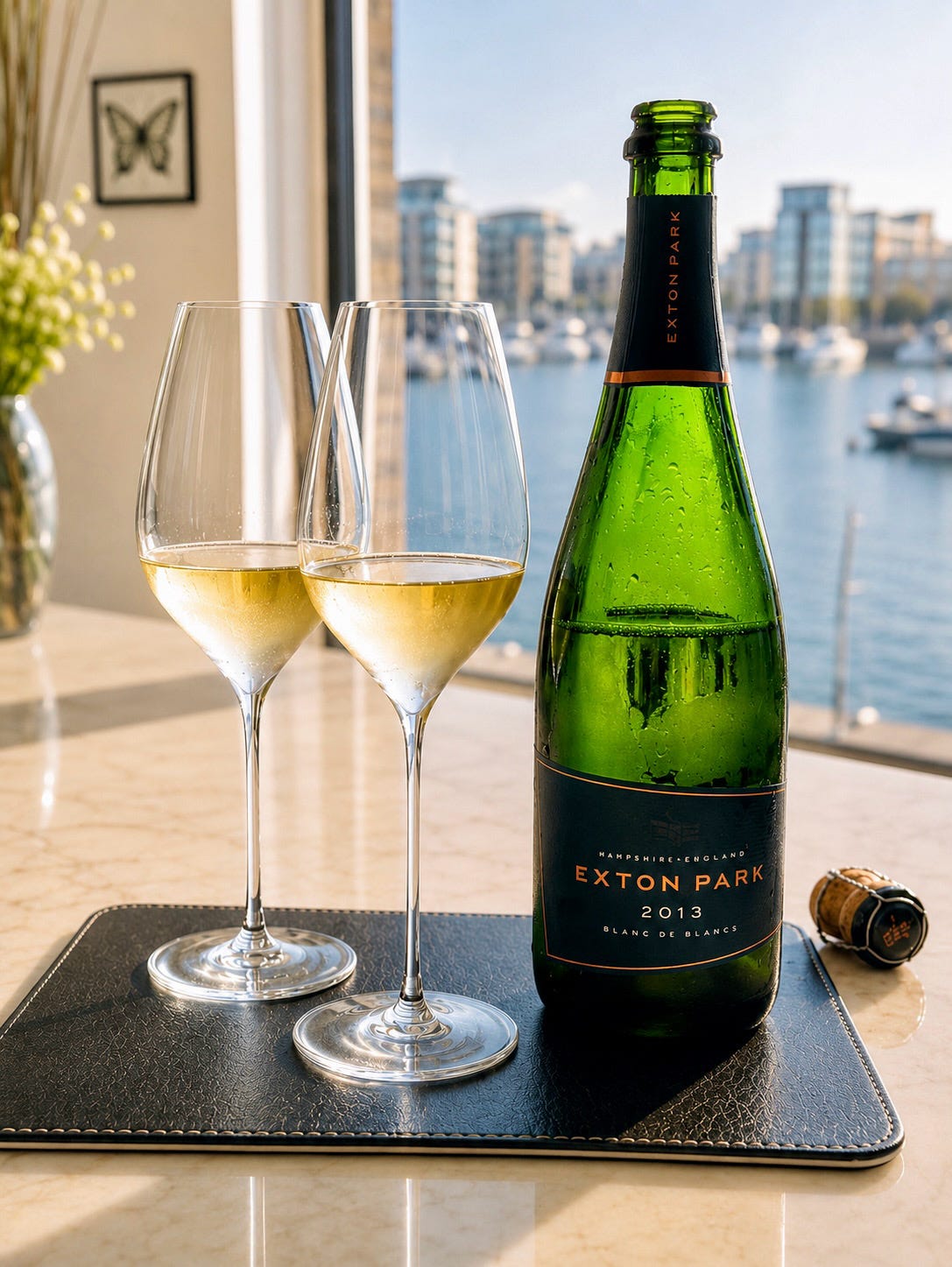
A vintage from a house that avoids them
To see why the Exton Park Blanc de Blancs 2013 deserves the attention, you have to understand what Exton Park usually declines to do.
The estate’s story begins not in wine but in watercress. Its late founder, Malcolm Isaac MBE, made his name and his fortune as a pioneer of the British salad and watercress industry, and held the Meon Valley land long before it grew a single vine. When he turned it to wine, the brief was unhedged: to make among the best sparkling wine in England. Sixty acres of vines by the estate’s current reckoning, a single vineyard on South Downs chalk — the same seam that dips beneath the Channel and surfaces again in Champagne. To realise it he brought in vineyard director Fred Langdale and, as winemaker, Corinne Seely, whose grounding runs through Bordeaux at Lynch-Bages and Domaine de Chevalier, and who made the first vintages of Coates & Seely before coming to Hampshire.
It was Seely who, arriving in 2011, gave the house its defining idea. She knew from her Coates & Seely years that England would not yield a vintage every year; so the answer was to build reserves, vinify each parcel separately, and blend across years rather than bottle single vintages. A library of reserve wines, all from the one vineyard. That is the philosophy behind Exton’s signature Reserve Blends, and in England it is a defensible one — in a climate this capricious, consistency of character can express a place more honestly than the accident of any one harvest. Vintage wines, here, are the exception.
Which is what makes the 2013 worth pausing over. From a house built on the multi-vintage blend comes a wine made entirely from a single year: one hundred per cent Chardonnay, bottled in 2014 and then left. Eleven years on the lees before disgorgement in 2025 — a span the estate claims is the longest yet drawn from that vintage in English sparkling wine, and the kind of number one associates with serious Champagne rather than a category still, in the popular imagination, finding its feet. It was released not because a calendar demanded it, but because the wine, tasted and re-tasted, finally said it was ready. Seely has spoken of the extended ripening of 2013 giving her the chance to build real depth while retaining freshness — that balance being the thing she most enjoys exploring in these wines. The judges concurred: at the 2026 WineGB Awards it took the trophy for the country’s best aged sparkling.
It arrives into a lineage worth naming. Nyetimber is generally credited with establishing the English Blanc de Blancs in the 1990s, and the late-disgorged style has since been carried forward by Gusbourne, among others. Exton’s 2013 pushes the argument further — that the best English sites can age, and reward the patience.
In the glass, that patience shows. Autolytic depth leads — toasted nuts and a yeasty, bready warmth — with stone fruit and a lift of white blossom behind, and a thread of honey throughout. There is smoke, too: not oak, since this is a wine of steel and time, but the flinty, struck-match register that comes of high acidity, cool fermentation and long contact with the lees. It is a signature rather than an accident. The house uses much the same language for its Reserve Blends, and Anne Krebiehl MW found smoke, candlewax and oyster shell in one of the estate’s late-disgorged Blanc de Blancs, a wine she scored 97 points.
The palate is savoury, almost cheesy in its lees-drawn umami, a whisper of spice playing over the honeyed core; the acidity stays bright and thoroughly refreshing, and the finish is long, persistent, insistent. A wine of real richness and complexity, held in balance rather than shown off. Outstanding.
That savoury note is worth dwelling on, because it is not a one-off. Tasting the Cuvée M. Isaac ‘BBB’ 2015 last year — from the estate’s oldest Chardonnay vines, fermented and aged three years in barrel before five more on the lees, made in tribute to the late founder — I wrote down orchard fruit, honeycomb, brioche and, unmistakably, cheese, all strung on a mineral backbone. Different vintage, different vessel, entirely different intent; the same umami thread underneath. Which begins to explain how this house’s Chardonnay behaves beside a cheeseboard. It is not that the wine tolerates cheese. It has been speaking the same language all along.
The oldest cheesemonger, and a board six ways
If the wine has provenance, so does the board. Paxton & Whitfield was founded in 1797 and has been sourcing, maturing and selling cheese for more than two hundred and twenty-five years, making it Britain’s oldest cheesemonger; it holds a Royal Warrant of Appointment to His Majesty The King. There is a pleasing symmetry in tasting the Christmas selection of a Jermyn Street institution against a wine grown on chalk downs a county or two away.
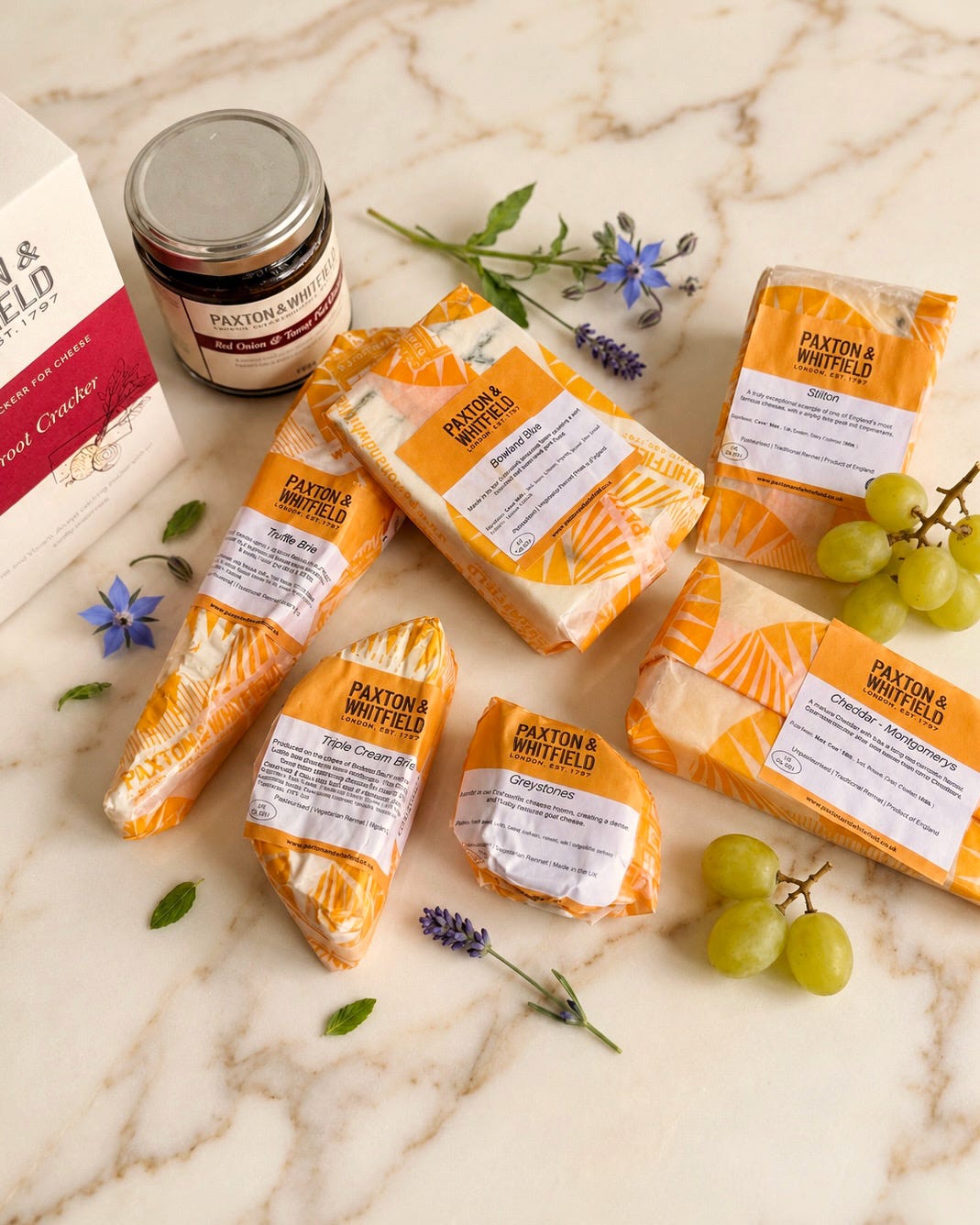
What struck me first, unwrapping them, was how much of this selection Paxton & Whitfield had finished themselves. Four of the six pass through the company’s Cotswold Maturing Room, where cheeses are held until the team judges them ready. That is a cheesemonger acting as affineur — and it is precisely what Corinne Seely did with the 2013, holding a wine back until it said it was ready rather than until a calendar said so. Both the board and the bottle are the work of people willing to wait.
The short answer is that this wine has the richness to carry all six. But two made the strongest case.
The first is Paxton’s Triple Cream Brie, and its provenance was the day’s surprise. Not French, but Cornish: developed out of conversations between the cheesemongers and their cheesemaker partners about whether Britain could answer Brillat-Savarin, it is built on rich cream from cows grazing Bodmin Moor. It is exactly the sort of cheese a lesser sparkling drowns in. Here the wine’s bright acidity and autolytic cut go clean through the cream, while its honeyed, bready register flatters the butter rather than fighting it. Richness meeting richness, and neither giving way.
The second is the Montgomery Cheddar, and here the parallel with the wine becomes almost too neat. Every batch is chosen personally by managing director James Rutter alongside the cheesemaker Jamie Montgomery — selected for its flavour profile rather than its age, with Paxton favouring a slightly drier style that develops deep brothy, savoury and gently yeasty notes. Judged by taste, not by the calendar: the cheesemonger’s version of a late disgorgement. And that yeastiness is the joint itself. The wine spent eleven years developing precisely those flavours on its lees; the cheddar arrives at them through maturation. Toasted-nut maturity answers earthy savour, acidity keeps the whole from tipping into weight, and of the six this was the pairing that felt inevitable. The piece we tasted was around sixteen months old, though by Paxton’s own logic the number is beside the point.
The others hold their own. The Hand Truffled Brie has a small cult behind it, and deservedly: brie from the Dongé family in France is matured in the Cotswold room, filled with a blend of Brillat-Savarin and preserved Italian black truffles, then returned to mature again into a single cheese. Truffle answers the wine’s own bready, savoury maturity — and there is a quiet joke in finding the French original inside one cheese and its British answer sitting a few inches away on the same board.
Greystones Goat begins as young Little Lepe, made by the Moody family in the New Forest, before Paxton’s quality manager Jazz Reeves and her team mature it until the texture turns dense, fudgy and intensely savoury. Its bright lactic tang meets the wine’s freshness as an equal — a pairing of likeness rather than contrast.
Bowland Blue is the most interesting thing on the board, and Paxton are candid that it is still a work in progress. It starts life as a young goat’s milk blue made in Lancashire from the milk of the cheesemaker’s sister’s herd; a further month or so in the Cotswold room turns it from light and fluffy into something denser, deeper, with a distinct treacle-like sweetness. That sweetness is exactly why it sits so comfortably here: treacle and honey recognising one another, neither party raising its voice.
And then the Finest English Stilton — made exclusively for Paxton by Cropwell Bishop, one of the last family-owned Stilton makers, and set with traditional animal rennet, which gives it a softer, creamier texture than most. It is their best-selling cheese every Christmas, and each December customers queue on Jermyn Street to collect the one that has become part of their family’s year. This is where a leaner English sparkling would falter, salt against austerity. That this wine does not is the entire point: its mature, honeyed weight is what lets it stand beside a serious blue and hold the line. It is the boldest match on the board, and the wine earns it.
A note on the rest of the box, because it matters more than garnish usually does. The selection arrives with beetroot crackers and a red onion and tawny port chutney, and that chutney is doing real work. The classic answer to Stilton has always been something sweet or fortified; here the port arrives on the plate rather than in a second glass, which is a neater solution than it sounds. A spoonful beside the blue, and the wine is freed to stay dry, bright and in character. The pairing is not the wine alone. It is the whole board, and a good cheesemonger has already thought about this.
Dan Bliss, who leads marketing and ecommerce at Paxton and who took us through the selection, frames the collection as a balance between heritage and innovation — tradition done exceptionally well on one side, and on the other the exclusives emerging from the maturing room. Tasted against a single wine, the division holds up. The traditional cheeses meet the Blanc de Blancs on grounds both parties have occupied for years. The new ones meet it somewhere less mapped, which is the more interesting encounter.
Six cheeses, other glasses
One wine across a whole board is a useful discipline, but it is not the only way to drink. For anyone building a Christmas table, here is where I would look next. A caveat worth stating plainly: the Exton Park was the only wine in my glass that day. What follows is drawn from principle and long habit rather than from the tasting itself.
Triple Cream Brie. Acidity is the entire answer to that much butterfat. A Chablis of premier cru weight — unoaked, saline, taut — cuts without adding richness of its own. Dan Bliss, leading the Paxton tasting, made the case for Gamay and for Gewurztraminer here — the first low in tannin and high in acid, untroubled by soft cheese; the second the bolder call, aromatics and a touch of exotic sweetness set against all that cream. On the Gamay I would reach for a cru Beaujolais such as Fleurie.
Hand Truffled Brie. Truffle wants earth and age. A mature Pinot Noir — a Burgundian village or premier cru with eight or ten years on it, forest floor just beginning to show — meets it without tannin blundering into the cream. Failing that, an older Champagne, where autolysis and truffle recognise one another instantly.
Greystones. The oldest rule in the book, and still the best: Loire Sauvignon Blanc. Sancerre or Pouilly-Fumé against a lactic, ash-coated goat has never needed improving. To step away from Sauvignon, a dry Chenin from Saumur or Vouvray offers the same acidity with more texture beneath it.
Bowland Blue. That treacle sweetness does not call for heavy artillery. A German Riesling with some residual sugar — Spätlese, or a Kabinett from a ripe year — has the acidity to keep pace and the sweetness to round the blue’s edge. Moscato d’Asti is the lighter, more festive option.
Stilton. Port, of course — a cliché only because it is right. A tawny of ten or twenty years, nutty and gently oxidative, is the more elegant partner than a young vintage bottling. Sherry answers too: Pedro Ximénez for decadence, a dry Oloroso for something more savoury.
Montgomery’s Cheddar. Nut meets nut: an Amontillado or dry Oloroso is a superb and under-used match for a mature clothbound cheddar. For a red, the old English answer holds — claret, or a Rioja Gran Reserva with bottle age, where savoury development answers the cheese’s own.
If you would like to do this yourself, Paxton run guided virtual tastings one Friday evening a month: £45 including delivery of a box of four or five cheeses and crackers, enough for four to share, hosted live by one of their cheesemongers. The Christmas gifting collection lands in early October, and the advent calendar opens for pre-order from late August.
The recalibration
None of this asks us to swap Champagne for English sparkling out of loyalty. It asks something smaller and more useful: that we taste what is in front of us, out of season and out of habit, and let a pairing earn its place rather than assume it. An aged English Blanc de Blancs turns out to belong at the English Christmas table not by patriotism but by palate — and not because it was grown next door to the dairies. It was not. The milk came from Somerset and Cornwall, Lancashire and the New Forest, and one cheese began its life in France. What the wine shares with the board is not a parish but a habit of mind: the willingness to leave something alone until it is ready.
The best thing a glass can do beside a plate is disappear into it — to make the food taste more like itself. On the evidence of this board, Britain’s best aged sparkling does exactly that. Less a trend to follow, then, than a quiet correction: the discovery that what we reach for at Christmas may have been within reach, and within these shores, all along.
—-—
The Exton Park Blanc de Blancs 2013 was provided as a press sample by Mentzendorff. The Paxton & Whitfield Christmas selection was tasted at a press preview and provided as a sample. All opinions my own.
Can’t wait to try the Exton Park Blanc de Blancs 2013!